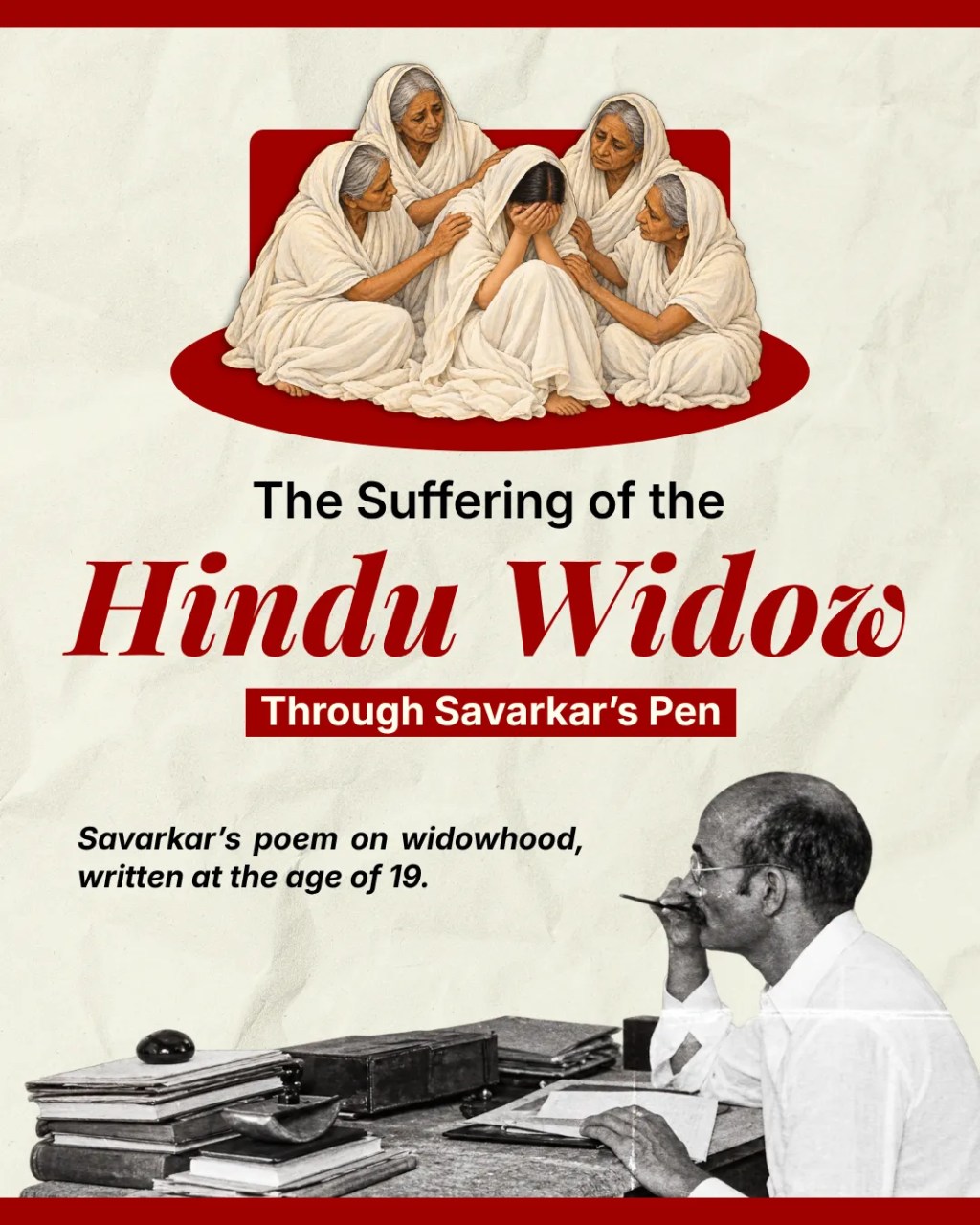
The Plight of Hindu Widow
By Vinayak Damodar Savarkar (1902)
INTRODUCTION
The Hemant Vyakhyanmala Committee of the Hindu Union Club, Bombay, had announced a prize of twenty rupees for the best poem on a prescribed subject. Among the many poems submitted to the committee, those by Shri Shripad Narayan Majumdar, B.A., and Shri Vinayak Damodar Savarkar were judged to be of almost equal merit. Accordingly, ten rupees were added to the original prize money, and both poets were awarded fifteen rupees each.
The subject prescribed by the examiners:
“The plague that is raging at present should serve as a mirror reflecting the plight of Hindu women who have suffered the calamity of widowhood at a tender age. An attempt should be made to find remedies that might alleviate their suffering. Through poetry, an appeal should be made to people holding both new and traditional beliefs, encouraging them to act in this direction.”
This poem reflects the development of Savarkar’s poetic craft and the breadth of his social outlook.
THE POEM
I. THE PLAGUE ARRIVES
- It seemed as though stones born of famine had been fashioned to enslave,
And a palace of ruin had been raised, adorned with deadly gems. - This land, enchanting as a sandalwood grove, the finest in the world,
Beholding it, I thought, “How blessed I shall be!”—such was the plague’s own aim. - It reached the land of the Aryas and firmly planted its feet in Bombay;
The joys of life came to an end, and calamities arose on every side. - The wonders I had heard of were surpassed a hundredfold by what I saw;
My heart was captivated, and I said, “There is no other place like this!” - Every day I saw new splendours in its many different quarters,
And resolved that I would settle here for many months to come. - Having made up my mind, I struck Bombay with terror;
Then, seeking fresh amusement, I set off for Pune, restless and wild. - I went to Trimbak with ease to bathe in the sacred waters,
Then arrived at Panchavati, where I went to behold the Lord. - What more need I say? I travelled throughout Maharashtra;
Swifter than the wind itself, I journeyed without the slightest fatigue. - “What plague are you talking about, brother? This is but the fruit of past deeds!
Can anyone escape the consequences of karma without being born to suffer them?” - Towns became dreadful, forests grew dense as towns,
And the entire populace, despairing, seemed stripped of all its strength. - Streets ran red as though vermilion had been poured across them;
Blood-loving figures danced upon those crimson roads. - The cry of “Chant the name of Lord Ram, brothers!” echoed throughout the town,
While the fever born of plague raged fiercely among those stricken by it. - Smoke from ominous rites filled the houses everywhere,
Accompanied by the widowers’ sorrowful cries of lamentation. - “O beloved! O beloved! Answer me, I call out to you!
How shall I drive this heavy cart of household life with one wheel gone?” - “I am empty-hearted; the woman who dwelt within my heart has departed!
Wait but a moment, beautiful one—I am coming. Do not weep!” - And from another direction, whose tender voice was that, sobbing?
Ah, now I understand—a little child was weeping softly in grief.
II. A CHILD’S LAMENT
- “Father, Mother left me only yesterday; now you, too, have left me.
Why have you departed today, in such haste, to reach heaven?” - “Or have you gone to join her there and keep her company?
But, Father, I am not yet strong enough to live by myself!” - Ah! How the heart is scorched by these sweet yet piercing cries!
From where do they come? Are they the voices of departed souls? - “My beloved, the very lake in which my life’s fish swam—
How has that pure and gentle stream of love suddenly disappeared? - Why will you not speak? Why are you displeased with your unfortunate wife today?
I stand here trembling, my beloved; please show me your love once more! - We had not even enjoyed a full year of married life together!
My dear, why have you gone alone to the realm of Yama, the god of death? - Do you remember those moonlit nights, those tender hours of love we shared?
Those days seemed to pass like mere moments, so sweetly did they fly. - When I was alone, you once came to frighten me;
Hearing your footsteps, I cleverly thwarted your little plan. - Did you take offence at that and fall silent, only to frighten me again?
I am already so frightened, my beloved; I shall never laugh again! - Sometimes you would sulk for no reason, angry without a word;
Yet soon, without even realising it, you would begin speaking to me again. - How often you would grow angry over the smallest things and turn away!
And how often we would smile when our eyes met once more! - Do you remember all of it? Does remembering bring you happiness?
Then why will you not speak? My heart is already aching with fear. - So my husband is truly gone? Has my mangalsutra been broken?
O Lord Ram! How could my heart itself not break as well? - Is there anyone who can now deliver me from this calamity?
Whom shall I turn to, now that my fate has been shattered? - When a woman’s husband dies, she becomes poorer than a cow;
Is it right that Death should claim such helpless women as these? - No brother, no relative, no loved one will remain of any help to me.
I am so miserable—has even the Lord no compassion for my suffering?
III. THE WIDOW’S PLEA
- I am but a young girl, and the treasure of my good fortune has been consumed;
The dreadful mountain of widowhood has crashed down upon me with all its force. - What can I possibly do? Listen, my dear relatives and loved ones!
All of you who witness my anguish, please come to my aid. - Will anyone ever answer the desperate appeal of a helpless woman?
Speak, please speak! Give me words that might restore my courage. - Alas! Why would anyone pay attention to a helpless woman’s misery?
Everyone is occupied with their own happiness, their ears firmly shut. - My relatives, can you hear these words, heavy with pain?
Do you believe my suffering is real, or do you think it false? - Show compassion for just a moment, and consider my plight together.
Abandon blind obstinacy; do not turn your backs on justice. - Ever since the plague arrived, efforts have been made to treat the afflicted;
Yet none achieved success, and in the end, lives were lost. - There was much debate about “inspection” and “disinfection,”
But every effort to drive away the plague proved fruitless. - Yet I do not blame you for that failure, dear people;
As the wise have said, “When sincere effort fails, who is to blame?” - But what of the tender girls upon whose homes the mountain of widowhood has fallen?
Whose bodies have suddenly been consumed by the fire of separation? - Have you made any effort to ease the unbearable sorrow
That has befallen them and brought about their widowhood? - What sort of “inspection” will you arrange to remedy their plight?
By what spells or incantations will you remove their ill fortune? - These poor girls were helpless to begin with, and now they are orphans of a kind;
Alas! People will look upon them with eyes of contempt. - A husband’s untimely death makes the whole world seem empty to a woman;
If her parental home is poor, her life becomes all the more unbearable. - “She is the ill-fated woman who devoured her own husband!” they say;
Her brothers-in-law and sisters-in-law stand ready with arrows of cruel words. - At this moment, there is no one left whom I can lovingly call my own,
No shoulder upon which I may rest my head and weep out my sorrow.
IV. THE CRUEL BURDEN OF WIDOWHOOD
- Other young women of my own age live lovingly beside their husbands;
Seeing them, the fire of separation burns within me ever more fiercely. - I constantly hide my face, ashamed to appear before other people;
With difficulty, I struggle through whatever days of life remain to me. - My eyes are forever filled with tears, wetting my tender cheeks;
The glow has left my body, and I waste away, as though consumed by disease. - I never even dreamed of desiring another man besides my husband;
After his death, I renounced every other pleasure in life. - The bare earth is now my bed; I eat only once a day;
I am expected to live like those chaste women whose praises are sung in religious hymns. - Even the sight of her face is declared inauspicious; she is called an ill omen for the world.
These ignorant, wicked people call a beautiful, divine cow a donkey! - If a widower’s remarriage is not considered inauspicious after his wife’s death,
Then why, pray, is a widow’s very presence condemned as an ill omen? - Why do people utter such cruel words of contempt and torment widows?
O Lord, why do You not punish the tongues of those wicked people? - Widowers may feast every day upon the richest and tastiest dishes,
While widows, restricted to a single meal, grow weak and helpless. - Widowers may burden themselves with fine clothes and ornaments,
While a widow’s body remains perpetually covered in the simplest garments. - The widower’s appearance and movements are considered auspicious;
Yet a teacher tells his pupils, “Even the sight of a widow’s nails is inauspicious!” - Men of sixty, though old, may take young brides as wives;
Yet a woman widowed within a week of marriage is forbidden to remarry. - What sort of justice is this? Why such a difference between widowers and widows?
What crime have these helpless women committed? What is this punishment for? - Does the Shruti command that widows must always be considered inauspicious?
Do the sacred Vedic texts truly sanction their suffering? - Or is this the command of the Smritis? Is it established in the religious law books?
Or would a mind guided by sound judgement and reason ever consider it just? - A man’s social rights do not disappear upon the death of his wife;
Why, then, should a woman’s socially recognised relationship be destroyed when her husband dies?
V. AN APPEAL TO RELIGION AND REASON
- Whether through deliberate cruelty or merely through inherited injustice,
Our society treats widows so harshly that even outsiders would be astonished. - It is shameful, yet we have long accepted this as though it were beyond question;
But religion, justice, reason, and sound judgement all tell us otherwise. - Let us wash away the accumulated sins of this cruel and unjust custom;
By correcting this wrong, let us earn the merit that brings blessings even in heaven. - And now, as though to add poison to misfortune, the plague has descended;
Every day, countless young girls are widowed in this terrible calamity. - Some girls lose their husbands on the very night of their wedding;
Others hear the dreadful news before that night has even arrived. - This is no rare exception; it happens everywhere, day after day.
No blow could be more terrible or more devastating than this plague. - When a man’s wife dies, he eventually marries again and resumes family life;
He fathers sons and daughters and finds comfort and happiness once more. - An old man who loses his son may adopt another child;
And if a father dies, his son may still enjoy life’s blessings without him. - The scriptures and customs seem to offer remedies for everyone’s suffering;
Yet neither seems to awaken compassion for a widow within her own home. - The scriptures neglect those who are already tormented a hundredfold by social customs.
Do something now to rescue these helpless widows from their plight! - If even now you refuse to lift them out of their misery,
This mountain of sin may become too heavy for the earth itself to bear. - O Vedic scholars, religious teachers, social workers, and foremost reformers!
Show compassion and come forward to rescue these helpless women! - When a woman suddenly becomes a widow without even seeing her husband’s face,
Why should the modern society of our age refuse her permission to remarry? - Religious pride is no substitute for sound judgement, nor does it excuse its absence;
It is now an accepted principle that religious practice must respond to the conditions of its time. - Let religion be refined through knowledge and sound reasoning, in keeping with changing circumstances;
Do not stubbornly cling to rigid customs when circumstances demand relief. - The founders of religions, the knowers of sacred texts, and the masters of religious duties—
Even the great teachers have always proclaimed this very principle.
VI. A CALL TO RELIGIOUS LEADERS
- Even today, the revered heads of those very religious seats command our respect.
Let us all persuade them to help relieve the suffering of these helpless women. - A man of sixty may choose a young bride in the bloom of youth;
Yet we are not demanding that an elderly widow be compelled to remarry. - But for those who have scarcely known the happiness of married life,
What alternative is left if even the proposal of remarriage is rejected? - If you still refuse to support this cause openly and unequivocally,
This plague will destroy the very existence of womankind—see what lies ahead! - Perhaps you will laugh and ask, “Are men and women not equally threatened?
Why claim that womankind itself will perish?” - Then listen: women are already dying in numbers comparable to men;
But when a man dies, his wife, too, is treated as though she were dead. - Thus, a double calamity has descended upon womankind.
Rescue them, O Lord! Now, our hope rests with You. - You are the religious authorities whom we revere; without your support,
No decision will win universal acceptance, and no one will heed our plea. - Grant recognition to the marriages of these destitute child widows;
Show compassion, and establish the cause of justice and truth today. - If society behaves in an insulting and degrading manner towards widows,
Raise the staff of authority and put a stop to such conduct today! - Establish schools where widows may receive education;
Understand that ignorance can be wholly dispelled through learning. - “Educating women brings no benefit; it will only bring disaster!”
Tell me, you who say this: who has ever drunk nectar and still met death? - Do not reply that nectar is never given to demons.
Would anyone here ever call our own mothers and sisters demons? - Establish homes for orphaned girls where widows, too, may become learned women!
Earn merit through such a noble deed—would this not please the Almighty? - Teach them the wisdom of great minds, including ethics and proper conduct;
Remember, the rain of sound education will bring forth a harvest of knowledge. - A new community of educated women will arise here,
Strengthening future generations by imparting education within their homes.
VII. THE FINAL APPEAL
- Who among those possessing a good heart and a noble disposition
Would refuse to rescue his mother, daughter-in-law, sister, sister-in-law, or daughter? - Countless young women stand before us with their foreheads bereft of vermilion;
Even saints and holy men would lower their eyes in shame at this sight. - Young and old, those who favour the new and those who uphold the old,
Listen, dear people: make every effort to end the plight of widows! - Break swiftly the harmful chains forged by wicked and oppressive customs!
Free these helpless women from their misery, and earn the honour of doing what is right. - Let ignorance and oppressive customs be removed, and let true religion shine forth;
May God be pleased and bring joy to the hearts of those who worship Him. - Having invoked the Almighty, Vinayak, too, lays down his pen:
“The Lord of the Universe hears the prayers of His devotees and fulfils their wishes.”
Poona, 1902

