DURING THE student programme Chhatron ki Goonj in Pune this August, Rahul Gandhi, Lok Sabha LoP slams Manusmriti as “a brahmanical – patriarchal treatise hailed by the RSS and BJP”. While listening to the grievances of students over paper leaks and conditions of women in society, Gandhi calls out “Manusmriti ka mindset” while taking jibe at Yogi Adityanath & Sangh Chief Mohan Bhagwat. But this was not the first time Gandhi made his way to attack the Right by quoting Manu.
December 2024, Lok Sabha commemorating 75 years of the adoption of the Constitution, Gandhi accused the Hindutva fountainhead – Vinayak Damodar Savarkar for deeming Manusmriti over Indian Constitution. LoP quotes Savarkar :
“‘The worst thing about the Constitution of India is that there is nothing Indian about it. Manusmriti is that scripture which is most worshippable after Vedas for our Hindu nation and from which our ancient times have become the basis for our culture, customs, thought and practice. This book, for centuries, has codified the spiritual and divine march of our nation. Today, Manusmiriti is law’. These are the words of Savarkar…Savarkar has clearly stated in his writings that there is nothing Indian about our Constitution. He has clearly stated that the book India is run by should be superseded by this book. This is what the fight is about … [1]”
This bit is enough to understand that both Gandhi and his researchers did a shoddy job in reviewing what actually Savarkar wrote. Savarkar as we know today became a punching bag for non-right parties but hardly they know that even BJP or the Indian Right-wing politics has distanced from the actual ‘Savarkarite Predicament’. These alleged claims make the debate more interesting. The first claim that Savarkar said “the worst thing about the Constitution of India is that there is nothing Indian about it” has no historical basis. Even the website of Communist Party of India (ML) Publications claims the same by giving reference to an article Women in Manusmriti written by Savarkar [2]. This article, written in 1936, was the part of a series for a progressive marathi magazine Stree. Now, the point worth noting is that which Constitution had already been drafted and enacted by 1936? The whole process of drafting the Constitution started with the Cabinet Mission in 1946 to 1950. But then the question may arise to our readers – Did Savarkar believe that “Manusmriti is that scripture which is most worshippable after Vedas and was the basis for our culture, customs, thought and practice? No, Savarkar started his article by referring to the status of the treatise during that time as a setting of premise for the argument based on what the social and cultural relevance of smriti is in the society. Savarkar points out the contradictions in smriti. For him, smriti is not DIVINE, ETERNAL & MUTABLE, but a book of HISTORICAL INFORMATION and a form of INTELLECTUAL ANALYSIS. [3]
He argues that we may not know how our 200th great-great-great-grandmother lived? what was her name, what she used to eat or cook, what the social and religious customs of that time were, or what rituals were observed upon the birth of a child or the death of an elder. But through Manusmriti we can trace the rules and customs, jotted by Bhagwan Manu, of the Hindu Society at that time. And thus smriti is not a holy book but a history book [4]. If we regard Manusmriti as divine, we cannot explain the contradictions. However, if we regard it as a historical document, we can easily explain the contradictions.
Savarkar openly criticized some of the controversial verses from the treatise. For example – Verse 9 ; chapter 3 of smriti says :
(A man should not marry a girl) who is named after a constellation, a tree, or a river, or who has a low-caste name, or is named after a mountain, a bird, a snake, or has a menial or frightening name. [5]
Savarkar comments that Manu may want our daughter’s name to be polite and soft but our sanatani friends would now realize how impossible it is to abide by the rules and regard his commands as valid for all times. Further he argues :
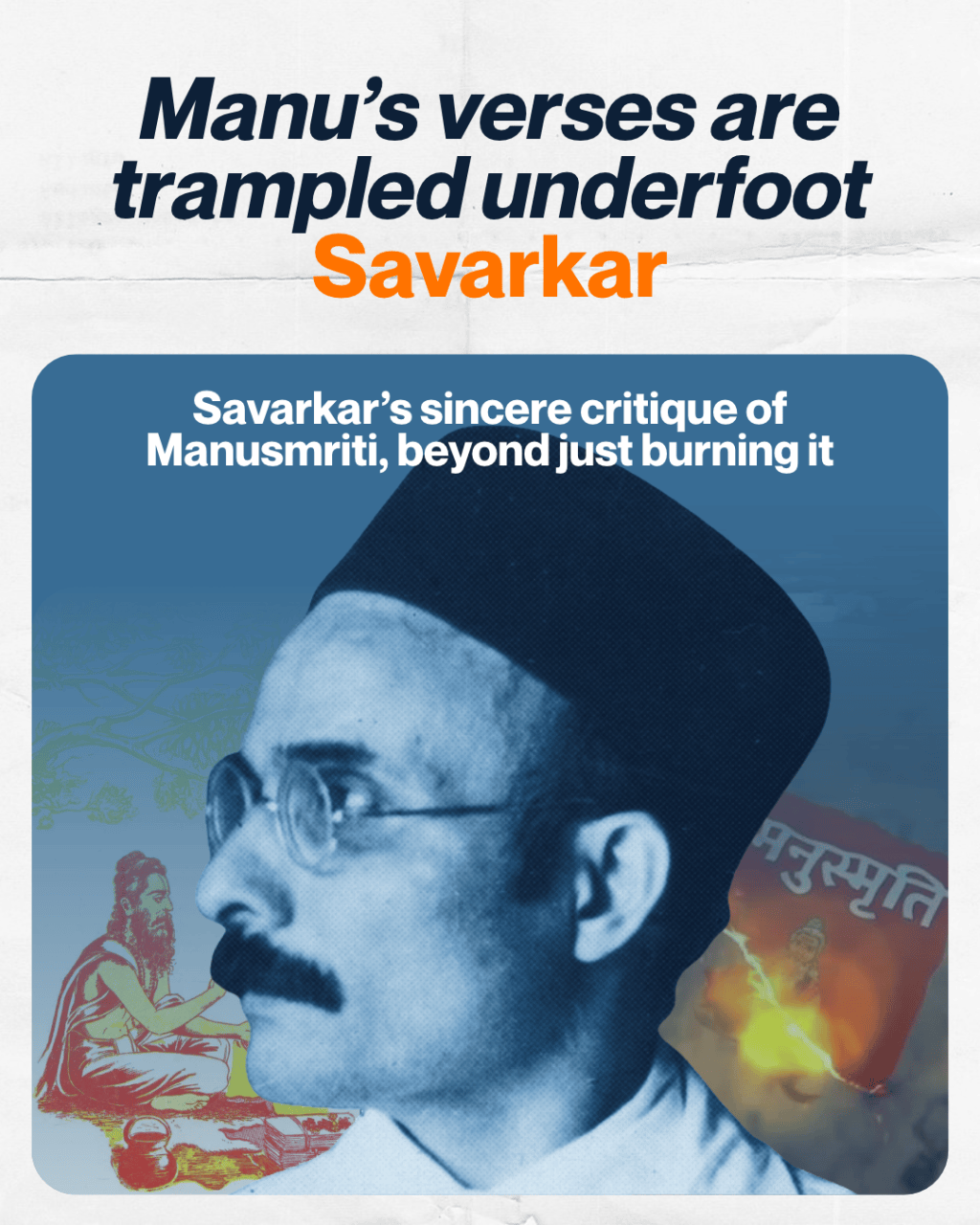
But if we were to follow these two simple verses, believing every word of Manusmriti to be eternal and inviolable, meaning eternal, dharma, then what a terrible disaster would ensue in every home! And that too not only in the homes of reformers, but also in the homes of Sanatan followers; for in this regard, it is the reformers who follow Manusmriti’s rules to a greater extent … Sanatan followers who consider Manusmriti to be eternally bound, Manu’s verses are trampled underfoot … (such as) naming girls after rivers is such a grave sin that it even prohibits the very act of marrying a girl. But in the homes of our Sanatani brothers, [girls named] Ganga, Godavari, Sindhu, Krishna, Kaveri, Narmada, and Jamuna flow brimming with water. Similarly, Manu considers the names of constellations to be derogatory, but in our homes, [girlchild named] Rohini shines continuously even in broad daylight. [6]
Savarkar shows that we don’t live our life according to Manusmriti thus it is absurd to impose greatness on such texts. That attempt to impose despicable ancient morality is laughable and prohibits progress. For him, many passages in smriti can provide valuable guidance to today’s problems but we should accept them because they are beneficial today, not because they were found in an ancient text and certainly not because Manu’s orders are not to be transgressed. Whatever we find in Manusmriti to be harmful or ridiculous today should not be followed, but that does not make Manusmriti harmful or ridiculous. In his own words, Savarkar says :
“For the [sic] nation-building in the contemporary era, whatever shlokas are useful, whether from Manu or others, we will follow them. Where they do not work, we will create provisions based on modern knowledge systems that would serve the interests of the nation. We will not accept the idea that the only criterion for distinguishing between truth and falsehood, good and bad, is that it is merely a norm for the present because, while it is true that old is gold, it is equally true that old is also often rotten and foul-smelling. “
Thus, the assessment of Savarkar is based on, not to foist the smriti but mandating a Secular-Socialist Constitution. The proposed Constitution of Hindu Mahasabha – ‘Constitution of Hindusthan Free State’ recommended adult franchise for all irrespective of sex and on a ‘one man, one vote’ basis. The voting age was to be twenty-one ; there was no question of weightage or reservation of seats and guaranteed to the citizens of free Hindusthan freedom from what President Roosevelt had termed as ‘Four Freedoms’: freedom from fear, freedom from want, freedom of expression and freedom of worship. Although Savarkar was not in the scene at that time, he had listed his thoughts on the Constitution of India. [7]
“Today, most all-India organizations have wholeheartedly welcomed the abolition of untouchability, as declared by our Constituent Assembly, from the Kashmir Himalayas to Kanyakumari. What makes this declaration even more remarkable is that the Chairman of the Drafting Committee of the Constitution, which included the provision to abolish untouchability, was none other than a man who was born an “untouchable” the Dr. B.R. Ambedkar! Did he assume this position by inciting an untouchable uprising and coercing the touchable Hindus at swordpoint? No! He was appointed to this position by the votes of representatives from all over India, belonging to various castes and regions. Moreover, the majority of these votes came from the touchable Hindus themselves! ” [8]
Author’s Verdict
It is as ironic as it is ludicrous, that the text Gandhi decided to quote Savarkar from, is itself a critique of Manusmriti. Today or even the times of Savarkar, no smriti is/was followed. There are several such examples written, which indicates that even the traditionalists do not follow it. But our core enmity does not lie with the treatise just because some of its shlokas are dreadfully ugly for modern society. Hypothetically, If we repeal the parliamentary process of Amendment in our Constitution today and scrutinize it after 2000 years, will our Indian Constitution be applicable to that era? The society constructs constitutions, the society, their current beliefs, customs & culture. After 2000 years, we can’t imagine what the ethos of such India would be and thus, today’s modern Constitution would not be suitable to the super-futuristic synthwave era. For that, the Constitution needs to reform itself with time. To prevent crimes or accidents resulting from the use of flying cars, or to avoid traffic jams in the skies, an amendment – ‘Air Traffic Police Bill – 4026’ must be passed with a full majority in that futuristic constitution. But giving this argument isn’t a scapegoat to the question of how Manusmriti really affected the lives of so-called lower castes by institutionalizing the Varnas. So, our tussle should be with those who want to impose smriti today.
NOTES
- https://www.ndtv.com/india-news/there-is-a-battle-taking-place-in-india-rahul-gandhi-in-lok-sabha-7246546
- https://publications.cpiml.net/book/utho-mere-desh-%E2%80%93-arise-my-country-real-face-of-sangh-brigades-nationalism/rss-views-on-india%E2%80%99s-constitution
- Savarkar Samagra, Volume 4, Prabhat, p. 416
- Ibid, p. 415-416
- The Laws of Manu – Penguin Classics, Penguin, p. 44
- Savarkar Samagra, Volume 4, p. 421
- Sampath, Savarkar – a contested legacy, Penguin, p. 376 & 379
- Savarkar Samagra, Volume 7, p. 238
– Soham, (Political Science student, University of Delhi)

