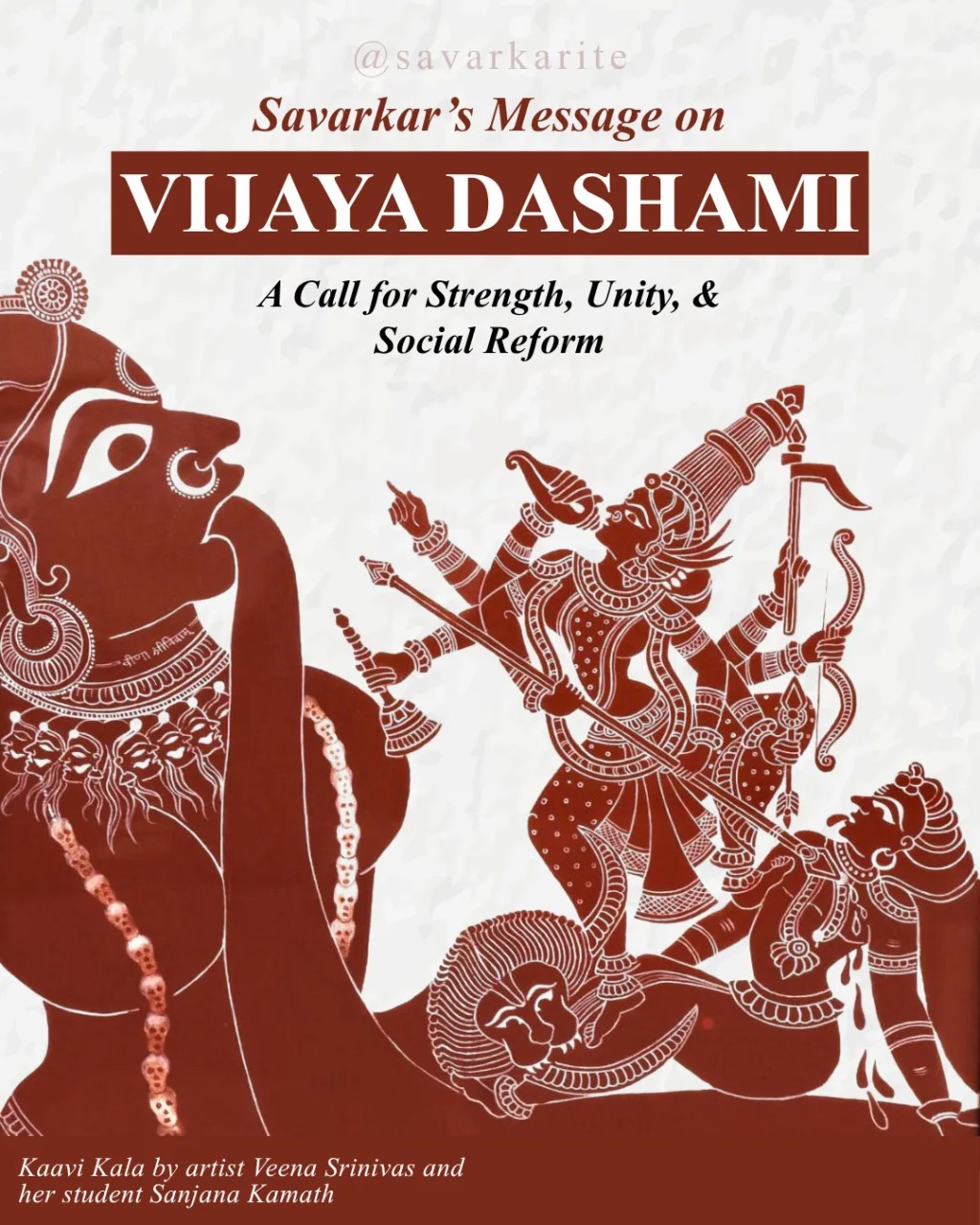
O Mind, Today You Have No Right to Indulge in Pleasure!
Translation of V. D. Savarkar’s essay on Vijayadashami, published in Shraddhanand on 9 October 1927 (Shalivahana Shaka 1849), reflecting on Hindutva, Shakti, Hindu Sangathan, and resistance to foreign invasions and subjugation.
On the beautiful night of Ashwin Shukla Ashtami, the moon was wandering cheerfully across the deep blue sky, showering its gentle moonlight upon the earth. The rain had only just stopped, and the entire sky appeared washed clean, shining with a purity like that of a newly bathed young woman. The cheerful face of the moon, which had remained hidden behind the clouds during the rainy season, appeared today as though it had emerged after many prayers and entreaties. A few chosen stars gazed at it in astonishment, their eyes fixed upon its splendour. Even after the entire army of the cloud king had returned to its camp, one stray cloud remained behind. Swaying upon the waves of the wind, it wandered sometimes near the moon and sometimes among the stars, like an old attendant moving restlessly from one place to another.
Just as the sky above appeared enchanting with the fresh beauty of autumn, the earth below was equally beautiful, covered with green grass, crops and tender shoots. It seemed as though some invisible guardian of the directions was pulling the strings of the wind and making the branches of trees sway in all ten directions.
As if searching for hungry people, these divine messengers, carrying handfuls of grain in their little hands, seemed to invite our gaze as they swayed across the fields in the form of different crops. They were bringing back the abundance of grain from God’s own storehouse, field after field.
The rivers flowing across the earth had filled their vessels according to their capacity from the cloud-filled reservoirs of the recently ceased rain. With cheerful hearts, they hurried towards the home of their beloved husband, the ocean, their nimble feet dancing upon the gentle waves. As they travelled, they sang melodious songs of joy hidden within their hearts, their murmuring waters almost putting the chirping birds to shame.
The lofty mountains stood in silent stillness, admiring the beauty of nature. They appeared as though the clouds that had wrestled across the rainy-season sky had grown tired, descended to the earth, and were resting motionless in groups at various places. Flowers had blossomed, vegetation had sprouted anew, happiness had spread across all ten directions, and the wind was showering the earth with fragrance.
Could God have written such a beautiful destiny for any other land? Which other land could have received such good fortune? Upon the forehead of which land, other than the sacred Hindubhumi, could the Supreme Being have inscribed such a blessing? If the gods themselves were ever to grow weary of heaven, where would they go to change their surroundings, if not to this land, so dear to my heart and beloved as life itself? In what other land could the thunderous monsoon, the extraordinarily beautiful autumn, and the colourful spring have been allotted such a magnificent share of splendour?
Therefore, O Mind, rise with pride at this immense good fortune. Become greater than the sky itself and prepare to savour this beauty.
Today is the eighth day of Navratri. For eight days and nights, the sacred lamp has continued to burn before the Goddess. Today, eight garlands have been offered to Goddess Durga, the wielder of many weapons, one for each day of worship. Today is Ashtami, the day of Mahishasura’s destruction. On this day, Mahishasura was slain, and numerous arrogant demons were crushed. Bhagavati Chamunda freed the earth from suffering.
Tomorrow, Navratri will conclude, and the day after, Vijayadashami, or Dussehra, will be celebrated with great joy. O Mind, prepare to wander freely in an ocean of happiness, for we celebrate Navratri to commemorate the memory of the mighty victory over the demons in ancient times. Rise now, O Mind, and let the praises of Bhagavati Ambika resound across all ten directions!
The mind, stirred by these thoughts on Ashtami, now looks upon the morning of Vijayadashami and asks: what is this that I see?
It is true that Bhagavati Jagadamba destroyed the demonic forces in those ancient times. But have those very demonic tendencies, once defeated, not risen again to trample the virtuous and plunge this sacred land into suffering?
Where is the banner of freedom that Bhagavati Jagadamba raised after destroying the demons in those ancient times? Where is it today, on Vijayadashami?
O Mind, what kind of happiness are you hoping for?
In those days, after nine days and nine nights of fierce battle against the demons who tormented this sacred land, the tenth day dawned as Vijayadashami. But today, where have you performed the worship of Navratri to adorn and restore your helpless Motherland?
How, then, can you claim the right to happiness today?
All that glory has disappeared. The victorious banner of Bharati, which once rivalled the heights of the Himalayas, has been torn down. The Ayodhya on the banks of the Sarayu, once flourishing with the happiness of Nandanvan under the Ram Rajya of Lord Ramachandra, has become a ruin. Gokul, once resounding with the melodies of Lord Govinda’s flute, now cries out in anguish under foreign invasion.
The sacred land of Kurukshetra, where the destruction of the eleven akshauhinis of the demonic Kaurava army paved the way for Swarajya, has fallen into ruin. And the Bhagavad Gita, which destroyed discord among the people and awakened the spirit of heroism, has become confined to the passive and lifeless recitation of its verses.
The enemy has grown arrogant, while our friends and companions are being tormented. The body of Mother Earth is bound by the heavy, rattling chains of subjugation.
Tell me, O Mind, what right do you have to be happy?
Yes, music brings joy to the ears. Poetry delights the sensitive heart. Philosophy offers the mind a mysterious sense of satisfaction. Painting fills the heart with delight. All this is true. But when can these pleasures truly be enjoyed?
When the country is burning under foreign subjugation, can you enjoy them?
When your Dharma, your community, and your culture are insulted at every step, can you enjoy them?
When the sanctity of your women, your deities, and your temples is being violated by the wicked, can you enjoy them?
When your Shraddhanand and your Rajpal fall victim to the demonic violence of cruel men, can you enjoy them?
When serving your own Dharma, community, and culture with complete devotion means becoming a victim of the weapons of assassins, can you enjoy them?
No, no, no, O Mind! Under these circumstances, you have no right to pursue pleasure alone.
When the cries of Motherland reach your ears, how can you claim the right to listen to music? When the arrogant are insulting your people, how can you immerse yourself in philosophical contemplation? When the terrible destruction of your culture stands before your eyes, who can claim the right to painting without becoming a participant in that sin?
Who can claim the right to celebrate the joy of Vijayadashami without undertaking the terrible struggle of these nine nights to destroy all demonic tendencies?
Therefore, O Mind, today you have no right to indulge in pleasure.
“Then how should Vijayadashami be celebrated today?” What is this question you are asking?
In ancient times, on the banks of Lake Pampa, Lord Ramachandra sat through the days of Navratri, contemplating this very question while Bharat was passing through a condition of distress much like the present. Like Bhagavati Jagadamba, he too had not yet achieved victory. Nevertheless, to secure that victory, on the auspicious occasion of Vijayadashami, Lord Ramachandra resolved to slay the arrogant Ravana of Lanka.
When the five Pandavas had entered their period of incognito exile, disguising themselves as Ballava, Brihannala and others, they too cast aside their sense of helplessness on this very day and took up the weapons of heroism.
Although victory may not be achieved immediately on this day, the resolve to attain victory has, since ancient times, proved fruitful. Therefore, today, everyone must take a solemn pledge to achieve victory.
On this very auspicious and heroic occasion of Vijayadashami, the saffron flag and the Jaripatka of the Marathas and Hindus once set forth from their sacred ports, with their armies surging like the waves of the ocean. Their spears were so radiant that even the Sun seemed to shine brighter as they hurled them high into the sky before departing on campaigns of conquest.
Sometimes they marched south to crush Haidar Ali; sometimes westward to punish arrogant Mughal rulers for their wickedness; sometimes to defeat the English at Wadgaon, where the English had suffered defeat; sometimes to overthrow the treacherous Nizam; and sometimes to frustrate the conspiracies of the French.
It was on the auspicious occasion of Vijayadashami that the armies of the Maratha state departed on these campaigns of conquest. That same sacred day is before us today!
This holy day must be celebrated by making a similarly extraordinary resolve. More than a hundred years have passed since foreigners seized our Vijayalakshmi, the Goddess of Victory.
O Mind, to liberate her, you must now abandon your attachment to all pleasures and dedicate yourself wholeheartedly to the task.
O Mind of the Hindu community, today you must worship Goddess Durga, the deity of power, to put an end to the insults inflicted upon the Hindu community. Where even great gods have been defeated without the support of the Goddess of Power, what standing does an ordinary human being possess?
Therefore, O Hindu Mind, if there is one thing you must resolve to do on this auspicious occasion, it is to worship the Goddess of Power.
All the happiness of the world depends upon the Goddess of Power. The capacity to protect every form of justice and philosophy resides in her strength. If the deity of power of a nation becomes powerless, the nation’s Goddess of Fortune will also lose her vitality.
If the sword of a nation breaks, its pen, its brush, and its veena break with it.
True progress does not come merely from writing numerous books on philosophy. It comes from the strength of one’s arms. When the Goddess of Power descends into the heart and flows through every vein, God Himself comes to her assistance.
In this world, no one comes to the aid of the weak, and there is no greater fault than weakness.
Whenever, during the reigns of Emperor Chandragupta and Vikramaditya, the Indian sword was empowered by the presence of the Goddess of Power, the arrogance of the arrogant was destroyed. At such times, Vijayadashami truly became a radiant celebration of Bharati’s divine victory.
O Mind, ever since this Goddess of Power became displeased with you, because you neglected her, your decline began.
If tyrannical tendencies and demonic desires are not checked in time, they bring about complete destruction. And this task of restraining them cannot be accomplished without the support of power itself.
Therefore, on this most auspicious occasion, it is essential to pay heed to this eternal and immutable principle.
Today, the Hindu community faces a grave crisis. On one side, foreign rule is gathering all its strength to erase it from existence. On the other, the tyrannical tendency associated with Islam is making its utmost effort to hollow it out from within.
At such a time, the victorious and valiant Hindu Mind must undertake the vow of building a powerful physique and celebrate Vijayadashami accordingly.
Through both Sangathan (organization) and Shuddhi (purification), we must confront Islamic and Christian incursions. Only then will our culture endure for ages.
Every Hindu youth today must either be equipped with a staff or be armed. Just as a young man should have a moustache upon his lips, he should have a stick in his hand. Even if he shaves his moustache in accordance with changing fashions, he must not abandon his stick. Such must be the intensity of his devotion to the Goddess of Power.
On this auspicious occasion of Vijayadashami, gymnasiums must be inaugurated in every village and town, and branches of the Hindu Sabha must be established.
By destroying untouchability, every Hindu must distribute the golden virtue of touchability on this Vijayadashami. The mind must be prepared to confront the many difficulties that may arise along the path of organization and purification.
Only then will this Vijayadashami bear fruit. Only then will the sanctity of all temples and women be protected, and Ram Rajya and Dharma Rajya will once again be established upon this sacred land of Bharat.
O Mind, only then will you become entitled to happiness.
Until that time, no matter how beautiful nature may appear, how delightful poetry may be, or how profound philosophy may seem, you have no right to enjoy the pleasures they offer.
Therefore, O Hindu Mind, cast aside all doubts today and resolve to achieve a victory on this Vijayadashami, a victory like that attained by Bhagavati Jagadamba herself.
Only then will the Goddess of Fortune of the Hindu land smile upon you.
(Savarkar Samagra, Volume 10, Page 477)

