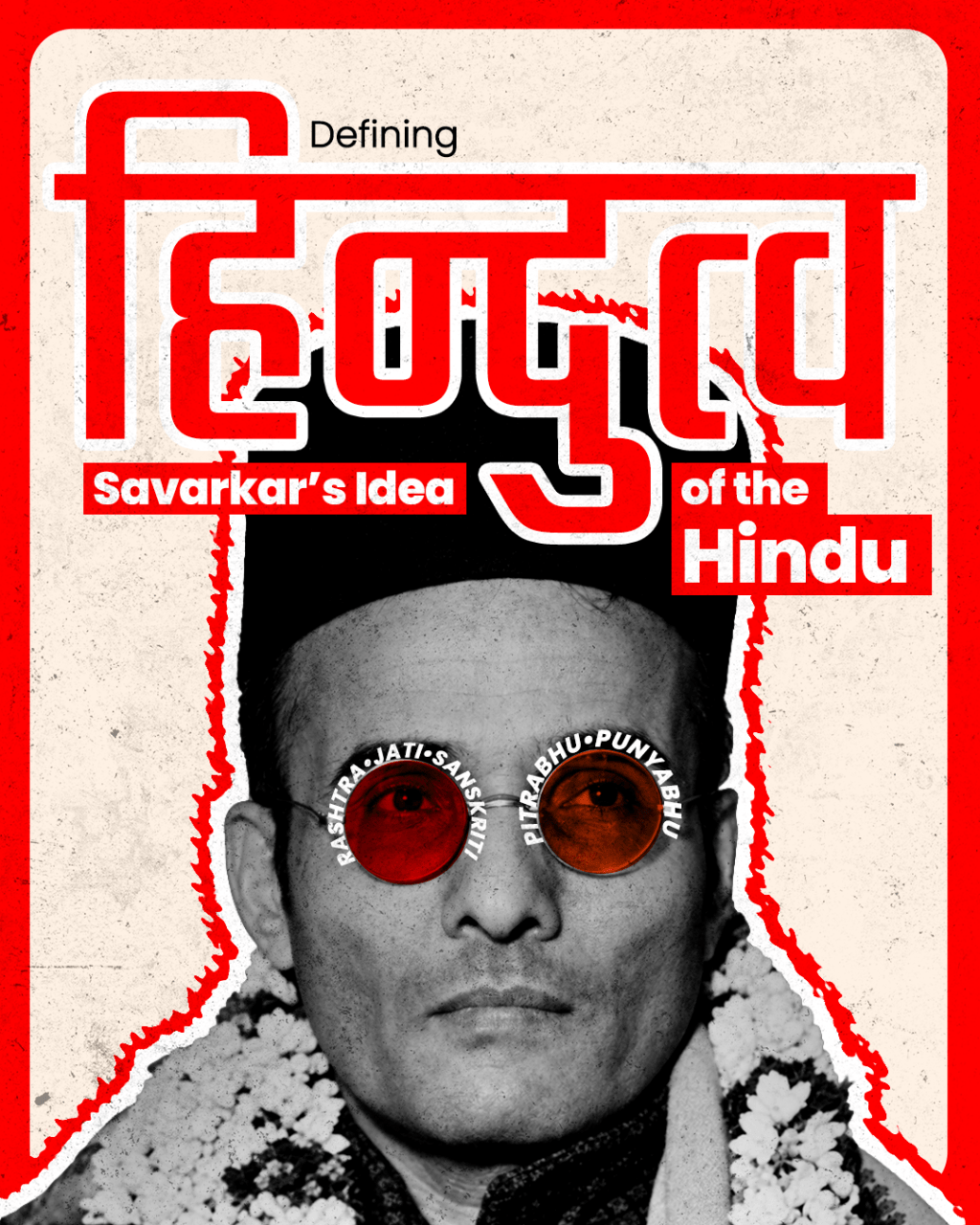
In Essentials of Hindutva, V.D. Savarkar presents Hindutva as a broad conception of Hinduness, extending beyond the boundaries of religious doctrine. It encompasses the historical identity of the Hindu people, their relationship with their ancestral land, and the civilization that developed through their collective history.
Savarkar begins by making an important distinction between Hindutva and Hinduism. He writes that “Hindutva is not identical with what is vaguely indicated by the term Hinduism” and describes Hindutva as “not a word but a history.” Hinduism, in his formulation, is only a part of this larger historical identity.
To understand Hindutva, therefore, Savarkar first asks a more fundamental question: Who is a Hindu?
The Meaning of “Hindu”
Savarkar traces the term Hindu to Sindhu, the ancient name associated with the Indus and the region of the Sapta Sindhus, or seven rivers. He discusses the historical development of names such as Aryavarta, Bharatvarsha, Sindhusthan and Hindu, and the way these names came to be associated with the land and its people.
For Savarkar, however, the significance of the word Hindu cannot be reduced to its linguistic origin. Over centuries, the term came to represent a people who had developed a common historical existence in the land between the Sindhu and the seas.
The meaning of Hindu, therefore, becomes inseparable from the history of the people who came to be identified by that name.
This is why Savarkar considers it necessary to distinguish the word Hindu from the more limited idea of Hinduism. If Hinduism is understood only as a system of religious beliefs, it cannot by itself explain the larger historical identity represented by the word Hindu.
Hindutva and Hinduism
Savarkar’s distinction between the two terms is fundamental.
An “ism,” in his understanding, generally refers to a system of ideas, beliefs or doctrines. Hindutva, by contrast, encompasses the broader existence of the Hindu people.
“Hindutva is not a word but a history.”
He further describes Hinduism as “a derivative, a fraction, a part of Hindutva.”
Hindutva consequently includes more than religious belief. It includes the history, culture, social institutions, traditions, literature, memories and collective experiences through which the Hindu people came to form a distinct civilization.
This distinction also allows Savarkar to discuss different religious traditions within the wider Hindu sphere. He specifically addresses Vaidik and non-Vaidik traditions and argues that Sikh, Jain and other traditions should not simply be excluded from the broader conception of the Hindu people merely because they differ in doctrine.
The Hindu as a People
Having established the broader meaning of Hindu, Savarkar turns to the idea of the Hindu people.
One of the principal elements in his definition is Jati.
Savarkar uses Jati in the sense of a common people or race. This is his terminology in the book and should be understood within his own historical framework.
He describes the Hindu people as the result of a long process of intermingling and assimilation. Rather than regarding the Hindu people as the continuation of one isolated ancestral group, he describes the fusion of Aryans, Dravidians and other populations.
He writes that the people resulting from this historical fusion are neither simply Aryan, nor Dravidian, but constitute what he calls the Hindu race. He explicitly includes communities such as Santals, Kolis, Bhils, Panchamas and Namashudras within this conception of the Hindu people.
Savarkar also emphasizes that differences of caste or sect do not necessarily destroy this larger identity. In one of his formulations, he writes:
“A Hindu marrying a Hindu may lose his caste but not his Hindutva.”
Here, Hindutva is presented as a wider identity than caste or sect.
The Hindu as a Cultural Community
Common ancestry alone, however, does not complete Savarkar’s definition.
The Hindu people also possess what he calls a common Sanskriti, or civilization.
This civilization is expressed through a shared historical and cultural inheritance. Savarkar refers to common history, heroes, literature, art, law, jurisprudence, fairs, festivals, rites, rituals, ceremonies and sacraments. Sanskrit occupies an important place in this inheritance as the classical language through which much of the civilization was expressed and preserved.
Savarkar is careful to distinguish civilizational unity from complete uniformity. He acknowledges that different Hindu communities may have different customs and practices. What matters is the larger body of culture that they share.
As he puts it, the question is not whether every Hindu possesses every detail of the civilization in exactly the same form, but whether there is more shared cultural inheritance among Hindus than between a Hindu and peoples belonging to other cultural traditions.
Sanskriti therefore represents the cultural dimension of Hindutva.
The Hindu as a Nation
The third element is Rashtra, or nation.
For Savarkar, the Hindu people are not simply a population connected by ancestry and culture. They are also a people connected with a common homeland.
That homeland is described as the land extending from the Sindhu to the seas.
The relationship between the people and this land is expressed through the concept of Pitribhu, or Fatherland. The Hindu regards this land as the land of his forefathers and therefore as the geographical home of his historical community.
The land is consequently more than territory. It is the setting in which the Hindu people lived, developed, fought, created institutions and transmitted their civilization from one generation to another.
Rashtra, Jati and Sanskriti are therefore closely connected. The nation provides the land, the Jati provides the historical people, and Sanskriti represents the civilization created and inherited by that people.
Pitribhu and Punyabhu
At this point Savarkar introduces the distinction that gives his definition its most specific form: Pitribhu and Punyabhu.
Pitribhu means Fatherland. It refers to the land of one’s ancestors.
Punyabhu means Holyland. It refers to the land associated with one’s sacred traditions, religious teachers, prophets, sages, pilgrimage sites and spiritual inheritance.
For Savarkar, India is Punyabhu because the major religious and philosophical traditions of the Hindu civilizational sphere developed within this land. He refers to the Vedic sages and to figures including Mahavira, Buddha, Nanak, Govind, Basava, Chaitanya and others as part of this sacred inheritance.
The land therefore possesses both historical and sacred significance.
It is the Fatherland because it is the land of one’s forefathers.
It is the Holyland because it is the land associated with one’s sacred civilization.
Hindutva Beyond a Single Theology
Savarkar’s conception of Hindutva is not dependent upon adherence to one particular philosophical position.
He explicitly recognizes differences between monists, monotheists, pantheists, atheists and agnostics. In discussing Hindu thought, he writes:
“Are you a monist—a monotheist—a pantheist—an atheist—an agnostic?”
He then presents these positions as capable of existing within the broader Hindu intellectual tradition. He also invokes Charvak, the materialist and atheistic school, as an example of the diversity of philosophical thought within India.
The significance of this passage is that, in Savarkar’s formulation, Hindutva is not defined by one answer to the question of God.
Its defining elements lie instead in the historical, national and civilizational relationship between the Hindu and the land and people of Hindustan.
The Three Essentials of Hindutva
The different strands of Savarkar’s definition finally come together in three terms:
Rashtra, the common nation.
Jati, the common people or race.
Sanskriti, the common civilization.
Savarkar states this directly:
“These are the essentials of Hindutva—a common nation (Rashtra), a common race (Jati) and a common civilization (Sanskriti).”
These three elements describe different dimensions of the same identity.
Rashtra establishes the relationship with the homeland.
Jati establishes the relationship with the historical people.
Sanskriti establishes the relationship with the civilization inherited from that people.
Pitribhu and Punyabhu then bring these elements together through the relationship between the people and their land.
The Definition of a Hindu
Savarkar ultimately brings the entire conception together in his definition of a Hindu.
A Hindu is one who regards the land extending from the Sindhu to the seas as the land of his forefathers, inherits the historical identity of the people who developed there, claims their civilization as his own, and regards that same land as his Holyland.
His definition includes the common history, literature, art, architecture, law, festivals, rites, rituals and other elements of the Hindu Sanskriti.
He then gives the definition in its most concise form:
“he is a Hindu to whom Sindhusthan is not only a Pitribhu but also a Punyabhu.”
This formulation brings the entire conception of Hindutva together.
Hindutva, as defined in Essentials of Hindutva, is therefore the broader identity of the Hindu people as a nation, a historical people and a civilization. Its three principal elements are Rashtra, Jati and Sanskriti, while their relationship with the land is expressed through Pitribhu and Punyabhu.
In Savarkar’s formulation, Hindutva is consequently not limited to a particular religious doctrine. It encompasses the historical, national and civilizational identity of the people who regard the land of Hindustan as both their Fatherland and Holyland.

