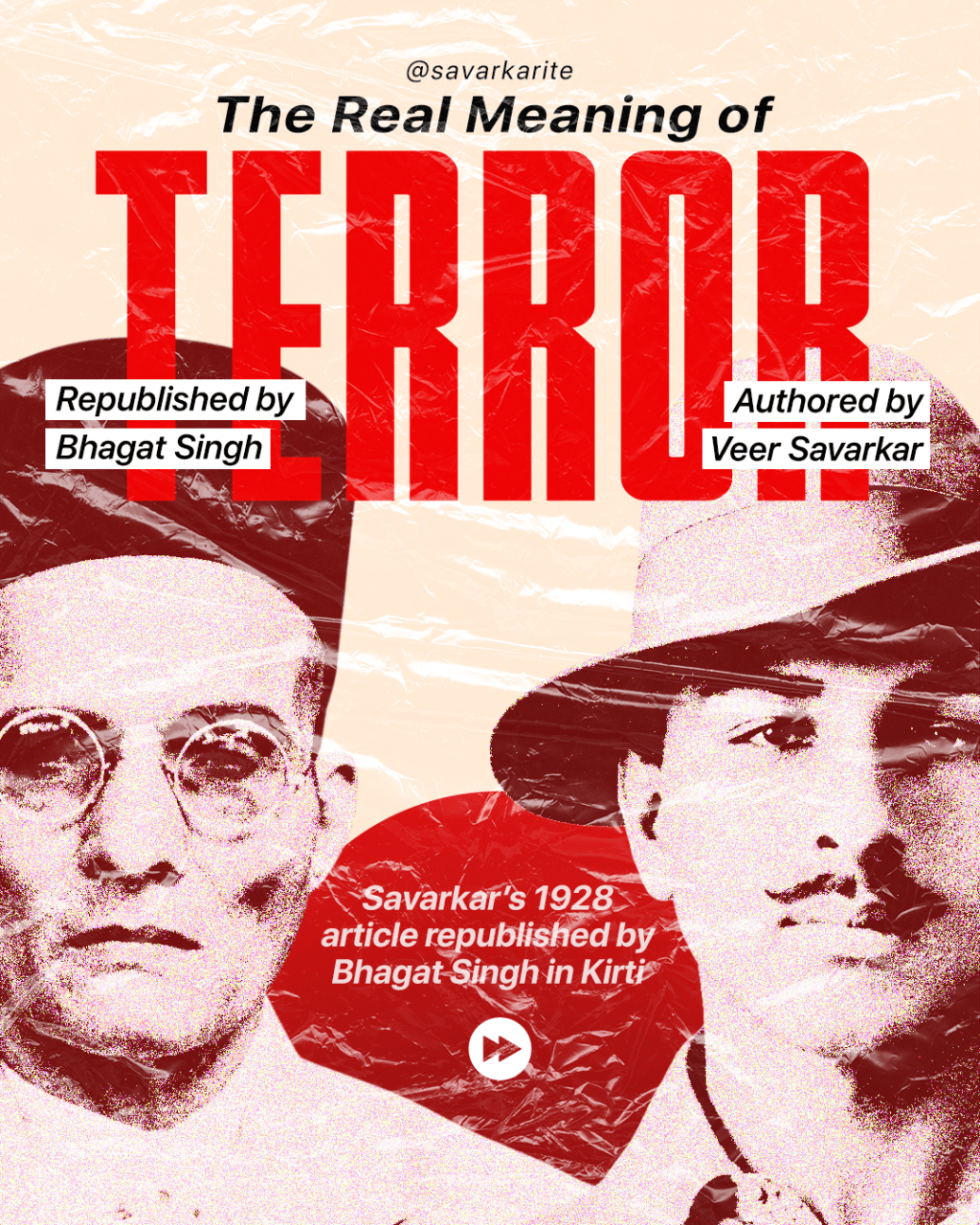
While participating in the ideological debates of their time, Bhagat Singh and his comrades tried to understand the meaning of the word “terror.” This article, published in Kirti in May 1928, appeared originally in the Bombay newspaper Shraddhanand and was translated from it. It represented the views of Bhagat Singh and his comrades at that time. — Ed.11
The Real Meaning of Terror
Over the past seven or eight years, among the words that have created a storm in our political life, and about which many people have remained under a misconception, the most important is the word “terror.” Until now, no one has seriously tried to understand the meaning of this word. That is why this word has continued to be used incorrectly. The entire nation, unable to properly understand its objective, has been stumbling along, mistaking day for night and night for day.
The moment one speaks of “terror,” one instinctively feels that it is a condemnable and evil word. On hearing it, the thought immediately arises that it means causing suffering, oppression, coercion and injustice. Whatever act is associated with the word “terror” begins to appear impure, harmful and reprehensible. In such circumstances, it is natural for any decent and kind-hearted person to try to remain permanently away from it. Terror and oppression mean the improper use of force. Both these words certainly imply the use of force, but there is a limit to the use of force. Without paying attention to that distinction, some agitators have given the name “terror” to it, and in the Hindi language have placed the word “non-violence” against it. Because of this, a very dangerous misconception has spread today.
Terror also involves the use of force. Therefore, some inferior minds have equated the use of force itself with terror. To prevent someone from doing a bad deed, it is enough simply to declare that the deed is very bad and hateful. “Terror” is one such word. In accordance with the Congress’s instructions, thousands of people went on taking oaths of peace without any objection. The idea itself was sound. Terror means oppression and coercion. What objection could anyone have to taking an oath not to commit such an evil act? But the real point is that, instead of oppression, the use of force itself was labelled “terror,” thereby creating a misconception among the people. Many people who were in favour of the use of force did not have the courage to support “terror,” and they too quietly took an oath in favour of peaceful [methods of agitation]. This is why words such as non-violence created so much confusion. Thousands of acts that had until then been considered not only legitimate but even good suddenly came to be regarded as hateful. Courage, bravery, martyrdom, sacrifice, military duty, the ability to use weapons, boldness, and the bravery of crushing the heads of oppressors—all these qualities depended upon the use of force. Now these very qualities began to be regarded as incompetence and baseness! The misleading meanings attached to the word “terror” confused the nation’s understanding. Matters reached such a point that even breaking a stone idol with a hammer was considered within the scope of terror, and even holding a stick was regarded as terror. Then should an idol be broken with one’s bare hands?
Whenever a word is heard, peculiar emotions arise in the heart of every person, and because its meaning is immediately understood in a particular way, a person does not make much intellectual effort to get to the bottom of it. If, upon the arrival of an unknown person, someone says that he is a great sinner and a scoundrel, certain hateful thoughts naturally arise in the listener’s mind against him. An opinion is formed about that person without any further investigation. The same can be said about the use of words. The Vedas and Puranas have emphasised that whatever words are spoken should be used correctly, because great quarrels even among the gods arose from verbal confusion and caused enormous harm. Exactly the same condition has prevailed among us for the past seven years. Without examining the matter, the proper and improper use of force has immediately been declared “terror,” and condemned as hateful.
If a robber enters someone’s house with an axe, that is called an act of terror; but if the members of the household use a knife and kill the robber, that too is called an act of terror. In other words, even when force was used properly and with good intentions for the protection of oneself and one’s family, it was still called terror. Ravana forcibly abducted Sita—that was terror. And when Rama went to rescue Sita and cut off Ravana’s head, that too was terror! The oppressors who inflicted various kinds of tyranny upon Italy, America, Ireland and other countries were regarded as spreading terror, and those who treated these foreign robbers, who held naked swords, with a concealed sword were also given the title of “terrorist.” Garibaldi, Washington, Emmet and de Valera were all placed in the same list. Can this be called justice? A thief who cuts the throat of an innocent child in order to steal jewellery is hateful, but the just emperor who hangs that hard-hearted thief on the gallows is also called a terrorist and hateful! Krishna is then just as sinful as Kansa! The heroic Bhima is just as guilty as Dushasana, who dishonoured his virtuous wife! Ah! What a misunderstanding. What a great injustice. This is why some simple-hearted people began to call even good deeds improper and terrorist merely because they involved the use of force. A snake bites, and a man kills it. But the two are not equal. Biting was the snake’s nature, and it was compelled by that nature; but the human being did it deliberately, and therefore he should be considered more base! Matters reached such a point that even the brave men who went armed into the battlefield and became martyrs for their country and nation came to be regarded as sinners. Shivaji, Rana Pratap and Ranjit Singh were called spreaders of terror, and even these revered personalities became objects of hatred.
Meanwhile, all the countries of the world are armed. Each continues to increase the strength of its weapons. And here is our India, where taking up a weapon is considered a sin. Those who taught “Do not even carry a stick” began patting the backs of cowards who were frightened at the sight of a stick. The bravery that could raise the country from its fallen condition and place it on the path of progress began to be destroyed, and those who feared force began to appear agreeable and willing to the enemy. There were only a few exceptional people who could not bear to see this unfortunate condition and began to oppose it. But the astonishing thing is that they themselves became victims of this confusion, and it became difficult for them to express their opposition through sound arguments. Thus, the people who wanted to transform the age, in irritation, began saying, “Yes, yes, we will spread terror; we will use Violence!” It was like a decent person who, seeing his good deed being declared a crime and being unable to provide a logical answer, becomes flustered and begins saying, “Yes, yes, I will commit the crime.” Exactly this was the condition of these unfortunate revolutionaries. Even the president of the Madras Congress said that if we are advocates of peaceful methods today, this does not mean that we will always remain so. It may be that tomorrow itself we may have to prepare for terror (Violence). The unfortunate thing is that the word “terror” is hateful. Because it has not been explained according to its proper qualities and correct meaning, it could not win over others to its side—that is, even those who favoured the use of force could not be expected to accept being called oppressors or terrorists. It is precisely because of the distortion of the meaning of this one word, “terror,” that such enormous harm is being caused.
The root of the entire misunderstanding lies in the wrong interpretation of this one word, “terror.” Since terror and oppression also involve the use of force, many good and bad things are done through the use of force. Oppression is one of them. A man secretly sets fire to someone’s house in order to steal; he too is someone who uses fire. On the other hand, a cook also lights a fire, but the cook cannot be called a criminal, nor can the act of lighting a fire itself be called bad. Similarly, when a patriot takes up arms to defend his country or to attain its freedom, and cuts down an oppressor with a sword, or is hanged while taking revenge on an oppressor on behalf of an oppressed person, or when a brave man takes up weapons to protect his relatives, his wife or his home and goes out to confront vile oppressors, he certainly uses force, but he does not spread terror. That is, the acts committed by such people cannot be counted as acts of terror; rather, they should be called good and noble.
Force that is used to torment innocent people without cause, or to harm others out of some base desire—only such improper use of force can be called terror. But when this same power is used to help a poor orphan or for some similar purpose, it is not terror; rather, it is virtue and benevolence. Thus, it follows that the use of force itself is neither oppression, cruelty nor terror; rather, it depends upon the intention of the person using the force. If he has used force for a good and noble purpose, he cannot be accused of terror. But if he has misused his strength for his personal interest or in order to cause suffering to innocent people, then he may unquestionably and without hesitation be called a “terrorist.” Terror is always worthy of hatred. Terror is such use of force as causes suffering to someone without that person having committed any offence. But when force is used to stop the hooliganism of oppressors and criminals, it is not terror but a good and virtuous act, because there is only one standard by which good deeds in the world can be judged—that they bring happiness and comfort to the world. To cause suffering to someone is terror, but to destroy the very existence of an oppressor who causes suffering is virtue.
When the tyrant Kansa takes up the sword of oppression and enters Devaki’s house, his action at that moment is hateful terror. But when Shri Krishna enters his court with a sword in order to free the people from the tyrant’s grip and separates his head from his neck with that sword, his action at that moment is worthy of praise. Both are swords, both are weapons, and force is used in both acts. But one act is full of oppression and therefore will be called terror, while the other is noble: it destroys the existence of an oppressor and tyrant, as though erasing a wrong letter, and thereby does good to the people. Therefore it is a noble and honourable act. But if we look at the matter according to our present philosophy, both acts are equally terroristic and hateful. The oppressor who causes suffering to people is a terrorist, and the person who frees people from the oppressor’s grip is also a terrorist! If this remains the situation in our country, how will we distinguish between good and evil, and how will we recognise the difference between honourable and hateful acts?
If it is understood that the improper use of force—that is, tormenting the poor and orphans—is called terror, and that preventing all such acts is considered good, then all confusion can disappear. When thieves, robbers and murderers use weapons, they commit terror (That force being aggressively used becomes violence). But when the owner of the house gets an opportunity and drives a knife into the chest of that robber or murderer, or when a just ruler sentences that robber to death, that is a good act. That is why Manu, the author of the Hindu legal texts, writes:
“Those brave men who secretly, openly challenging him in the field, or by some other means, attack and kill an oppressor, murderer or criminal are not sinners or guilty persons; rather, they are regarded as honourable men.”
According to the oldest as well as the newest laws, the use of force in self-defence has never been called terror. Even in Hindu penal law, it has not been called terror (Violence). Spreading terror is punishable, but the use of force in self-defence is regarded as lawful force.
Exactly the same is true in politics. Austria ruled Italy against the will of the Italian people, solely through the force of the sword. Therefore, Austria’s act of forcibly keeping Italy subjugated was terror, it was hateful, and it deserved to be ended. But when Garibaldi and Mazzini raised the sword against it and overthrew that oppressive monarchy, their act was not hateful; rather, it was regarded as worthy of worship and reverence. The same can be said about the struggle fought in 1857 for India’s independence, because according to what we have explained above, it was not oppression or terror.
To draw the conclusion from this article that we are encouraging an armed rebellion would be entirely false and pointless. Today we are not writing anything about whether an armed rebellion should or should not be undertaken. The maturity or otherwise of an armed rebellion depends upon the circumstances and news of different countries. Those who consider armed rebellion difficult or premature at the present time should not use the word “terror” as a cover to make the very idea of resistance appear unacceptable. It is precisely with this thought that the above definition of the word “terror” has been given, so that people may not once again commit the same dangerous and irreparable mistake.
(From “Shraddhanand,” Bombay)
Kirti, May 1928

